
Reviewed · CAPE COAST & ELMINA CASTLE TOURS
3 Days Accra City Tour & Cape Coast Tour
History takes center stage in Ghana. This three-day private tour combines Accra’s landmarks and markets with the sobering slave-route sites around Cape Coast, giving you both a city introduction and a serious look at the country’s past. I especially like the quiet setting of Asomdwe Park and the chance to walk above the forest at Kakum National Park. I also like the personal service: Mohammed has customized itineraries, while guides such as Maanan have been praised for patience, care, and strong local knowledge.
The main drawback is the pace. You cover a lot in only three days, and the 6:00 a.m. start means this is not a relaxed, sleep-late holiday. The program also does not specify meals, overnight lodging, or exact transport times, so you should confirm those details before paying.
In This Review
- Key points to know before booking
- What the three-day route is really trying to show you
- Day one: Asomdwe Park and Accra’s national symbols
- Ghanaian art and objects at the Centre for National Culture
- Day two: Kakum’s canopy bridges above the forest
- Assin Manso and the Slave River
- Day three: Cape Coast Castle’s dungeons and museum
- Elmina, the Portuguese post on the Gulf of Guinea
- Price, private touring, and what is included
- Guide service and the solo visitor experience
- Who should book this Ghana tour?
- Should you book the Accra and Cape Coast route?
- FAQ
- How long is the Accra and Cape Coast tour?
- What time does the tour start?
- Is pickup available?
- Is this a private tour?
- Are admission tickets included?
- Can most people participate?
- What is the cancellation policy?
Key points to know before booking
- Asomdwe Park gives your Accra morning a calm opening, with President J.E.A. Mills’ memorial site, birds, fish, and ostriches.
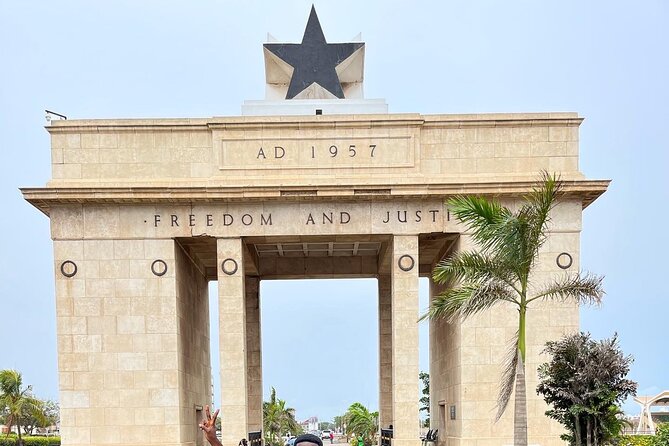
- Independence Square packs Ghana’s national story into one stop, including the Independence Arch, Black Star Gate, and Liberation Day Monument.
- Kakum’s canopy bridges are the active highlight, lifting you about a hundred feet above the forest floor.
- Assin Manso adds an essential human dimension, marking the Slave River and the final inland link before captives were taken to coastal forts.
- Cape Coast Castle and Elmina show two sides of the coastal fort system, including dungeons, museums, and European trading history.
- Private touring makes customization possible, with group discounts, pickup, and a guide focused only on your party.
What the three-day route is really trying to show you

This is not simply an Accra sightseeing package followed by a beach trip. Its shape is more thoughtful. Day one introduces modern Ghana through civic places, cultural displays, and a major public square. Days two and three move west toward the Central Region, where forests, slave-route memorials, castles, and coastal trade sites tell a harder story.
I like that mix. You get some lighter stops, such as the small animal area at Asomdwe Park and the forest walk at Kakum, but the tour does not avoid painful subjects. Assin Manso, Cape Coast Castle, and Elmina require attention and emotional space. If you want a holiday built only around food, shopping, and scenery, this may feel heavy. If you want context for Ghana and the wider Atlantic world, it is a useful route.
The private format matters here. You are not tied to a large bus group, and the provider can adjust the plan. Mohammed has been singled out for handling custom requests, including a last-minute addition. That flexibility can make a packed schedule easier to manage, though you should agree on any changes before the tour begins.
More Cape Coast and Elmina castle days:
- The Cape Coast Day Tour
★ 5.0 · 525 reviews - The Cape Coast Tour
★ 5.0 · 177 reviews - From Accra: Cape Coast, Elmina Castle & Kakum Park Day Tour
★ 4.6 · 144 reviews
Day one: Asomdwe Park and Accra’s national symbols
The first stop is Asomdwe Park, the memorial park holding the remains of former President John Evans Fiifi Atta Mills. The setting is described as peaceful, which gives you a gentle start after the early pickup.
There is also a small animal area with ostriches, fish, and birds. This is not a full-scale zoo, so keep your expectations modest. Its appeal is the contrast: a memorial site that also offers a quiet place to see a few animals and take a break from central Accra.
You have about 30 minutes here. That is enough for a short walk and a look around, but not enough for a long, unhurried visit. I would treat it as a brief orientation stop rather than the main attraction of the morning.
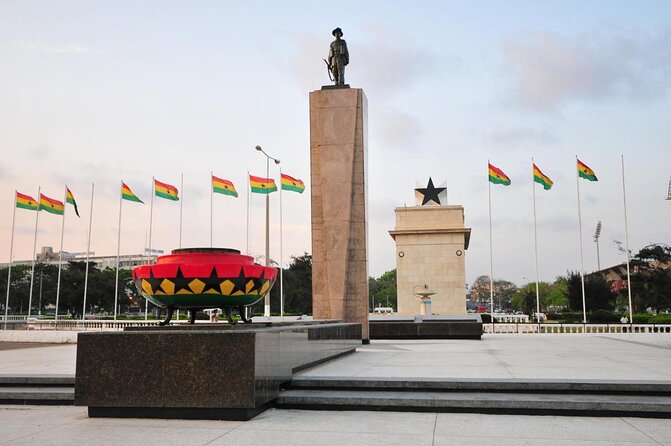
Next comes Independence Square, home to some of Ghana’s best-known national monuments. The Independence Arch, Black Star Gate, and Liberation Day Monument all relate to the country’s independence struggle and public identity.
This is one of the places where a good guide adds real value. The structures are large and easy to photograph, but their meaning is less obvious if you simply walk past them. Ask your guide to explain how the monuments relate to Ghana’s independence and national ceremonies.
The visit lasts about 40 minutes. That should give you time to see the main structures and take photographs. Because this is an open civic space, the experience may feel more like a public plaza than a formal museum. That is part of its value. You are seeing how national history is presented in everyday Accra, not just behind glass.
Ghanaian art and objects at the Centre for National Culture
The Centre for National Culture gives day one a more museum-focused finish. Its collection includes Ghanaian historical and cultural objects, along with material from neighboring West African countries.
That regional scope is important. Ghana’s story did not develop in isolation, and objects from nearby countries help place local traditions in a wider setting. The museum is housed under a two-tiered rotunda, giving the visit a distinctive architectural setting as well as exhibits to see.
You get about 40 minutes here. That is a useful amount of time for a guided introduction, but it is unlikely to satisfy someone who wants to read every label or study every collection in detail. I would use the guide to identify the most important displays, then spend your remaining time with the pieces that catch your attention.
Taken together, day one is a compact Accra introduction. It does not attempt to cover every market, neighborhood, or gallery. Instead, it gives you national symbols, public memory, and cultural objects in a manageable half-day-style sequence.
Day two: Kakum’s canopy bridges above the forest

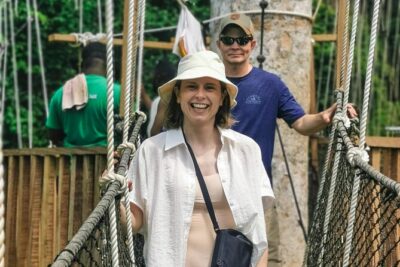
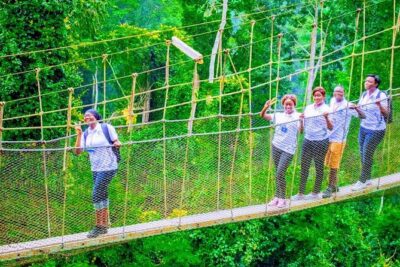
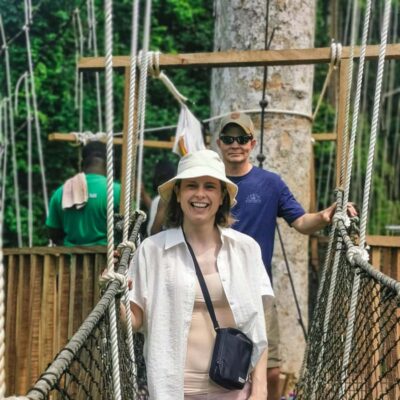
Kakum National Park is the most physically active part of the tour. The main attraction is the canopy walk, a series of wooden suspension bridges high above the forest floor. The bridges reach roughly 100 feet overhead, giving you views of the forest from a level normally reserved for birds and climbers.
You have about an hour at the park. That makes this a focused visit rather than a long hike. The appeal is the unusual perspective. From ground level, a tropical forest can feel closed in. From the bridges, you gain a broader view through the trees and a stronger sense of the park’s height and scale.
The word suspension matters. These are bridges that hang and move, so anyone uncomfortable with heights or swaying walkways should think carefully before booking. The tour description calls the activity a hike, but the stated time is short. Ask the operator about current trail conditions and the exact amount of walking if that is important to you.
Admission is included. Wear practical clothing and shoes suitable for a forest walk, though the supplied details do not specify a dress code or equipment list. The safest advice is simple: plan for an outdoor stop and allow yourself time to move carefully on the bridges rather than rushing for photographs.
Kakum also helps break up the more solemn historical visits. You are still learning about Ghana, but the lesson comes through trees, height, and physical movement instead of monuments and museum rooms.
A few more Accra trips worth weighing up
- Volta Region 3 Days 2 nights Nature Private Tour
★ 5.0 · 11 reviews - 3 Days Private Wanderlust Eco Tour in Volta, Ghana.
★ 4.5 · 9 reviews - 3 Days Grassroots Safari To Mole
★ 5.0 · 54 reviews - 3 Days Sunrise Elephant Safari-Mole Park with -Round Trip Flight
★ 5.0 · 6 reviews
Assin Manso and the Slave River
Assin Manso is one of the most meaningful stops on the route. It was the final link in the slavery route from northern Ghana and one of the largest inland markets supplying people to forts and castles along the coast.
The Slave River, known as Nnonko Nsuo, is part of the site. Captives were washed and sorted there before being sold to merchants. That fact gives the river a painful significance. It is not simply a scenic waterside stop. It is a place connected to the forced movement, inspection, and sale of human beings.
The site also includes a cemetery where Samuel Carson from the United States and Crystal from Jamaica were re-interred in 1998. Their burial here connects the location in Ghana with the African diaspora in the Americas and the Caribbean.
You have about an hour. That is enough for a guide-led visit to the river and cemetery, with time to pause and reflect. The setting is described as sacred, and you should approach it with respect. Keep your voice low, avoid treating the location as a casual photo backdrop, and let your guide set the tone.
This may be the stop that changes how you understand the castles on the coast. Before captives reached Cape Coast or Elmina, they passed through inland routes such as this one. Assin Manso supplies the missing link between the interior and the fortified coastal sites.
Day three: Cape Coast Castle’s dungeons and museum
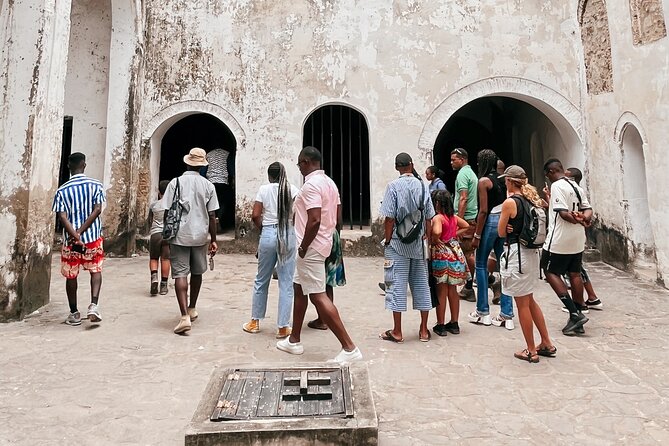
Cape Coast Castle brings the coastal chapter into view. The castle served as a slave castle and later became an administrative center for British rule in West Africa.
The visit includes the museum and the dungeons where enslaved people were held while awaiting shipment to the New World. The stated visit lasts about 45 minutes, so the guide’s presentation will shape much of your understanding.
This is a difficult place. The rooms and dungeons are physical spaces, not abstract historical dates. You may find the visit emotionally demanding, especially after seeing Assin Manso the day before. That is also why the stop matters. It places the system of forced trade in a real building, with walls and rooms you can see for yourself.
Fortified sites can sometimes feel repetitive after several visits, but Cape Coast Castle has a particular importance because of its role in both the slave trade and British administration. Pay attention to the shift in function over time. The castle was not tied to one single period or purpose.
The admission ticket is included. Since the visit is relatively short, I would use any available time before or after the formal tour to orient yourself to the castle’s setting and ask questions. The supplied schedule does not promise free time, so do not assume you will have a long independent exploration.
Elmina, the Portuguese post on the Gulf of Guinea
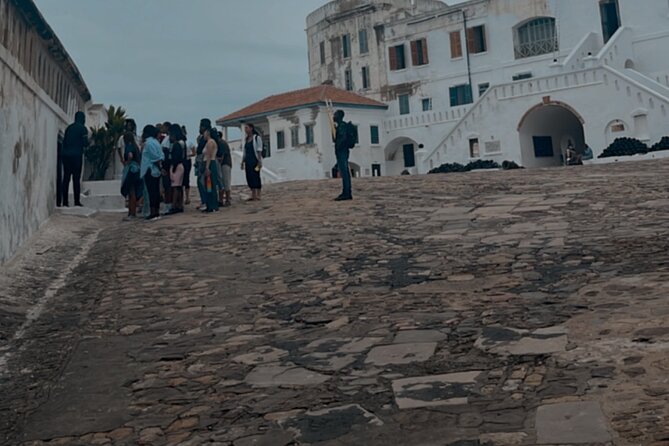
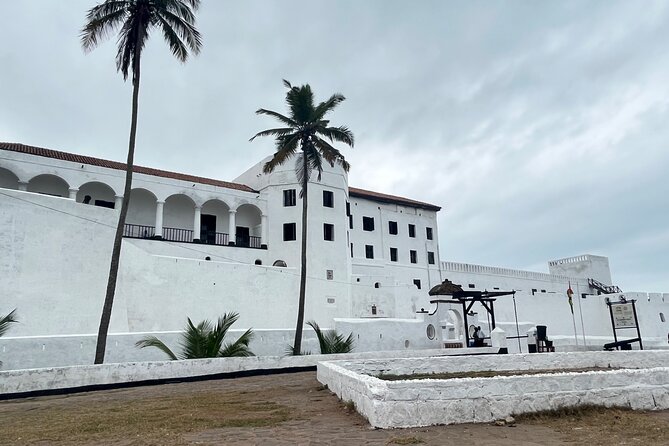
Elmina provides a different angle on the coast. Founded by Portugal in 1482, it is described as the first European trading post on the Gulf of Guinea and the oldest European building south of the Sahara.
The fort later passed to the Dutch in the 17th century and to Britain in the late 19th century. It protected an important port for the gold and ivory trade, and it later became involved in the trans-Atlantic slave trade.
Elmina Castle is part of a group of 18 fortified trading posts in Ghana listed as a UNESCO World Heritage site. That designation helps explain why the stop matters beyond its walls. You are looking at one site within a larger network of European-African trade, military power, and forced labor along the Gold Coast.
The planned visit lasts about 45 minutes, and admission is listed as free. The short time means you will want to stay close to the guide and focus on the main story rather than trying to examine every corner.
Cape Coast Castle and Elmina should not blur together. Cape Coast emphasizes its castle, museum, dungeons, and British administrative role. Elmina takes you further back to Portuguese trade and then through Dutch and British control. Seeing both helps you understand that the coast changed hands and functions over several centuries.
Price, private touring, and what is included
The price is $490 per person. That is a significant amount, but the value depends on what you want from the trip.
You are paying for three days, private participation for your group, pickup, an early start, and admission to most of the listed stops. The itinerary also links Accra with several sites around Cape Coast that would be difficult to organize efficiently without a dedicated operator.
The private format is especially useful for solo visitors, couples, families, or small groups who want to ask questions and adjust the pace. Group discounts may improve the per-person value if you are booking with friends or relatives.
Still, do not assume the price covers everything. The supplied details do not state that meals, hotels, or every transport expense are included. Ask for a written breakdown before booking. Clarify the pickup point, return point, overnight arrangements, and how much driving occurs between stops.
The tour ends back at the meeting point. Pickup is offered, but the exact pickup area is not stated, so confirm it in advance.
Guide service and the solo visitor experience
The strongest service detail is the human one. Mohammed has been praised for building custom itineraries and accommodating a last-minute addition. That suggests a useful level of flexibility, but you should still communicate your priorities clearly at the planning stage.
Maanan, also written as Mannan in the supplied feedback, receives particularly warm praise for patience, kindness, and local expertise. Those qualities matter on this route. You need clear explanations at Independence Square, careful context at Assin Manso, and a respectful presentation at the castles.
A solo visitor may find the private arrangement reassuring. One solo guest specifically described feeling safe and at home with Med and Richard while completing a full itinerary. That does not guarantee the same guide or exact experience for every booking, but it shows that the company has experience looking after people who arrive alone and feel uncertain about navigating Ghana independently.
Who should book this Ghana tour?
I would recommend it to you if you want a focused introduction to Accra and Ghana’s coastal history in a short window. It suits first-time visitors who prefer a guide, people interested in the African diaspora, and anyone who wants to combine culture with a small amount of outdoor activity.
It is also a good match for a private group that values flexibility. The ability to request changes may help families or friends with different interests.
I would hesitate if you want a slow itinerary with long meals, extended beach time, or broad independent exploration. The 6:00 a.m. start and tightly packed schedule favor coverage over leisure. People uneasy with heights should also ask detailed questions about the Kakum bridges.
Free cancellation is available if you cancel at least 24 hours before the experience begins. Within 24 hours, the payment is not refunded, and late changes are not accepted.
Should you book the Accra and Cape Coast route?
Book it if you want the main landmarks, forest canopy walk, slave-route memorial, and two major castles brought together by one private operator. The route is demanding, but its strength is the connection between places. Asomdwe Park and Independence Square introduce modern Ghana, Assin Manso explains the inland slave route, and Cape Coast and Elmina show the coastal system that followed.
Before you commit, confirm meals, lodging, transport details, pickup, and the exact overnight plan. If those arrangements suit you, $490 can be fair value for a private three-day program with admissions and personal guiding. If you want more time at each site, ask Mohammed to remove a stop rather than trying to squeeze in even more.
FAQ
How long is the Accra and Cape Coast tour?
The experience lasts approximately three days.
What time does the tour start?
The stated start time is 6:00 a.m.
Is pickup available?
Yes, pickup is offered. The exact pickup location should be confirmed when you book.
Is this a private tour?
Yes. Only your group participates in the activity.
Are admission tickets included?
Admission is listed as included for Asomdwe Park, Independence Square, the Centre for National Culture, Kakum National Park, Assin Manso Ancestral Slave River Park, and Cape Coast Castle. Elmina is listed with free admission.
Can most people participate?
The tour information says most people can participate. Kakum includes elevated suspension bridges, so ask the provider about that activity if you have concerns about heights or walking.
What is the cancellation policy?
You can cancel at least 24 hours before the start time for a full refund. Cancellations or changes made within 24 hours are not accepted for a refund.
Just added around Accra
- Experience Cape Coast Castle and Kakum National Park★ 4.5 · 3 reviews
- Experience Northern Ghana In 10-Days★ 5.0 · 3 reviews
- Discover Ghana – Wli Waterfalls, Mountain Afadjato, Monkey Sanctuary & Akosombo.★ 4.5 · 3 reviews
- Cultural Tour Of Ghana And South Africa 12 Days★ 5.0 · 3 reviews
- Accra: City Highlights Half-day Guided Tour with Transfers★ 4.1 · 3 reviews
- Accra: Half day private safari with pick up★ 3.5 · 3 reviews
- Full Day Accra Guided Tour★ 5.0 · 3 reviews
- Experience Aburi Botanical Gardens And Boti Water Falls In A Day.★ 5.0 · 3 reviews
Cape Coast & Elmina Castle Tours, compared.
Cape Coast, Elmina Castle & Kakum Park Day Tour
Read our review →
Cape Coast ,Elmina Castle and Kakum Full-Day Tour
Read our review →
10 Days Trip to Cape Coast and Elmina Castles from Accra
Read our review →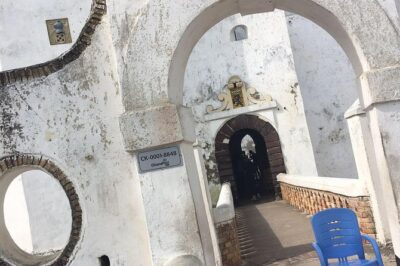
The Homecoming Experience To Cape-coast And Elmina.
Read our review →Browse the lists this tour appears in