
Reviewed · CITY TOURS
Accra Detailed City Tour
Accra reveals itself one busy street at a time. This private tour brings together the National Museum, Makola Market, Independence Square, Jamestown, and Labadi Beach, giving you a useful first look at Ghana’s capital. I especially like the mix of serious history and everyday city life, plus the chance to bargain for crafts and relax by the sea. The main drawback is transportation: depending on traffic and group size, you may use Uber, Yango, or a local taxi instead of one dedicated tour vehicle.
The tour is also flexible, which helps when Accra’s traffic or opening hours upset the plan. Guides named Clinton, Alex, and Kwame have been praised for being friendly, punctual, patient, and good at answering questions. Still, you should confirm the vehicle arrangement before booking, especially if you expect private car service from one stop to the next.
In This Review
- Key points to know before booking
- Why this Accra tour works well as a first look
- The National Museum sets the historical stage
- Makola Market brings you into daily Accra
- Independence Square explains Ghana’s national story
- Craft shopping at the Centre for National Culture
- Walking through Jamestown and its old forts
- The W.E.B. DuBois Center adds a Pan-African perspective
- Kwame Nkrumah Memorial Park honors independence leadership
- Labadi Beach gives the day room to breathe
- Transportation is the key point to clarify
- What $80 means in practical value
- Who should book this experience?
- Should you book the Accra Detailed City Tour?
- FAQ
- How long does the Accra Detailed City Tour last?
- Where does the tour start?
- Where does the tour end?
- Is pickup offered?
- Is this a private tour?
- What transportation may be used between stops?
- Are admission tickets included?
- Can I cancel for a full refund?
Key points to know before booking
- Seven major Accra stops in one private outing: Museums, memorials, markets, historic districts, and a beach are all included.
- Makola Market adds real city energy: You can browse local goods, take photos, and receive help with bargaining.
- History is a major theme: The National Museum, Independence Square, Jamestown, the DuBois Center, and Nkrumah Memorial Park connect Ghana’s past with its modern identity.
- Traffic can change the pace: The advertised duration is about three to six hours, but busy roads and stop lengths may stretch the day.
- Labadi Beach is the finish: You can end with food, drinks, and time to sit after a hot day in the city.
- Private group format: Only your own group takes part, with group discounts available and pickup offered.
Why this Accra tour works well as a first look
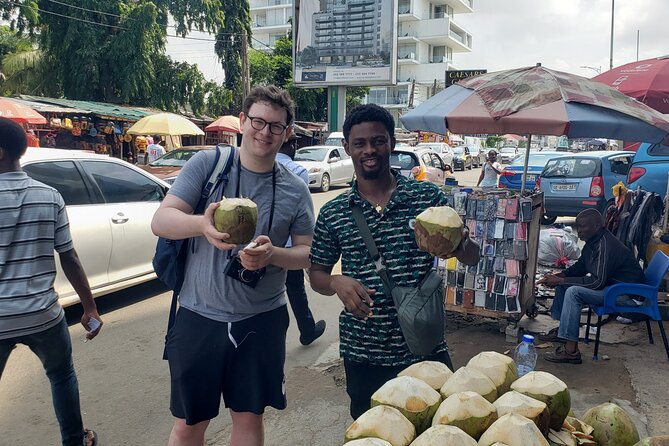
Accra is not a city you understand from a car window alone. Its meaning comes from the contrast between formal monuments, crowded trading streets, colonial-era buildings, craft stalls, museums, and the Atlantic shore. This tour tries to cover all of those sides in one day.
I like the overall design because it does not limit you to memorials and government buildings. You move from Ghanaian archaeology and traditional objects to market life, independence history, Pan-African thought, and beach culture. That range gives you a better sense of how Accra functions today.
The private format is useful. You can ask questions without waiting for a large group, and the guide can adjust the amount of time spent at different stops. One solo participant was able to ask many questions and received help rearranging visits when some sites were closed. That kind of flexibility can matter in Accra, where traffic and opening schedules do not always cooperate.
The pace, however, is ambitious. Even the listed stop times add up to several hours before you account for traffic, loading, walking, and meals. If you want a slow museum visit and an unhurried market wander, you may need to choose which stops matter most.
More city tours in Accra:
- Accra Guided City Tour Experience
★ 4.7 · 88 reviews - Accra Guided City Tour Experience
★ 5.0 · 76 reviews - Know Ghana in 4 hrs – Accra City Tour
★ 4.5 · 47 reviews
The National Museum sets the historical stage
The National Museum of Ghana is the best place to begin the historical side of the day. It opened in 1957 and is the largest and oldest of the six museums administered by the Ghana Museums and Monuments Board.
Inside, the archaeology section covers Ghana from the Stone Age through more recent history. The ethnography gallery includes chiefs’ regalia, musical instruments, gold weights, beads, textiles, stools, and pottery. Objects from other parts of Africa, including Senufo masks from Côte d’Ivoire and Zulu figures from southern Africa, widen the story beyond Ghana’s borders.
You are given about an hour here, with admission included. The museum may also have its own staff available to add context, which is helpful because some displays deserve more explanation than a quick glance provides.
I would pay close attention to the gold weights and traditional objects. They offer a practical way to understand trade, leadership, craft, and daily life. The museum is not simply a place to check off before the market. It gives the rest of the tour a useful frame.
Opening hours can affect the order of the day. A Sunday visit caused some planned locations to be closed, although the museum remained a highlight. If your schedule is tight, ask in advance which sites will be open on your chosen day.
Makola Market brings you into daily Accra
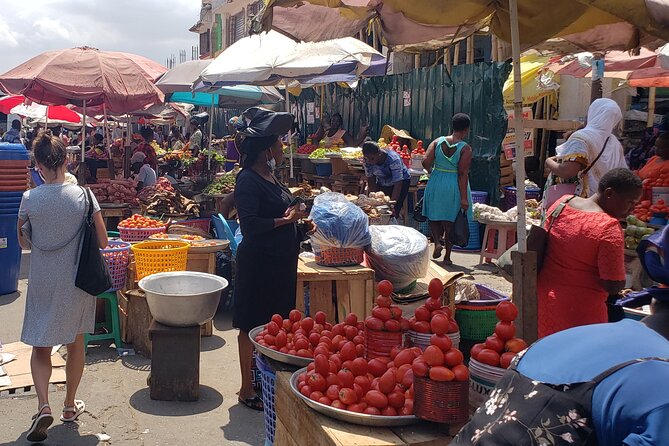
After the museum, Makola Market shifts the mood from display cases to real commerce. This central market district includes indoor and outdoor areas, with women traders selling a wide range of goods.
You have about 45 minutes here. That is enough for a first walk through the market, photographs, and perhaps a purchase, but it is not a long shopping session. The setting can feel crowded and fast-moving, so stay close to your guide and keep your belongings secure.
This is one of the most useful stops for understanding Accra as a living city. You see people working, negotiating, carrying goods, and handling the ordinary business of the day. The market is not arranged for sightseeing, which is exactly why it can feel more revealing than a polished attraction.
A guide can help with bargaining and explain local customs. That assistance is valuable if you are not used to prices being discussed face to face. My advice is to decide what you genuinely want before negotiating, and do not let the excitement of the market push you into buying more than you can carry.
Independence Square explains Ghana’s national story
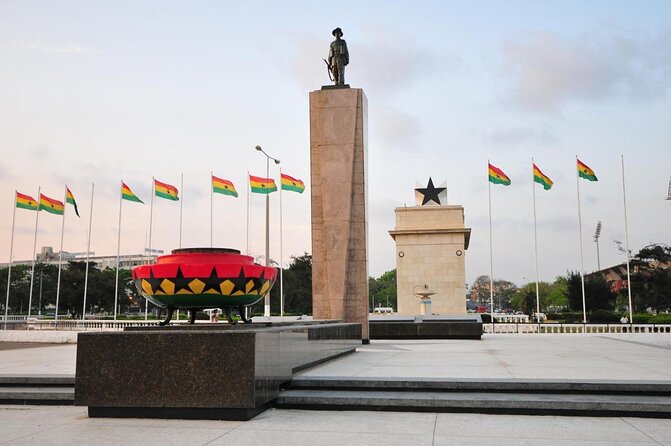
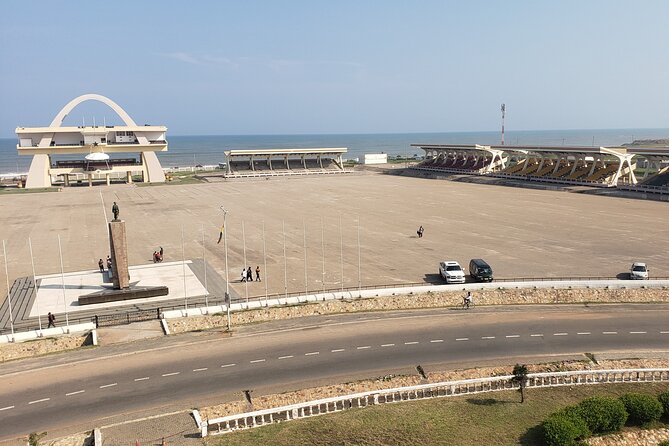
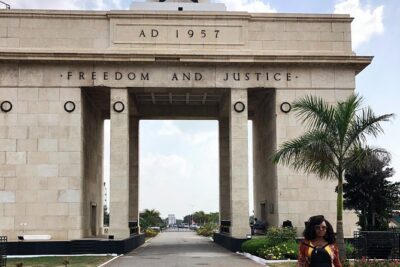
Independence Square is a more formal setting. Its monuments include the Independence Arch, Black Star Gate, and Liberation Day Monument. The area is tied to Ghana’s struggle for independence and the country’s public identity.
The planned visit lasts about 30 minutes. That is enough time to see the main monuments, hear the basic background, and take photographs. It is not intended as a long walking tour through the surrounding city.
This stop works best when your guide explains what the monuments mean rather than simply pointing them out. Independence Square can look spacious and ceremonial, but the symbols carry real weight. Ghana became independent in 1957, an important moment in African political history, and the square presents that achievement in monumental form.
Wear comfortable shoes and expect sun. The tour includes outdoor stops, and one visitor found the walking and heat difficult. A hat, water, and light clothing will make a noticeable difference.
A completely different sort of day out of Accra:
- The Cape Coast Day Tour
★ 5.0 · 525 reviews - Experience the Beauty, History and the Culture Of Accra in a Day
★ 5.0 · 323 reviews - The Cape Coast Tour
★ 5.0 · 177 reviews - From Accra: Cape Coast, Elmina Castle & Kakum Park Day Tour
★ 4.6 · 144 reviews
Craft shopping at the Centre for National Culture

The Centre for National Culture is described as the country’s largest craft market. Here, you can browse stalls, bargain for souvenirs, and receive extra lessons with drums or other local instruments from people at the market.
The planned visit is about 45 minutes. This gives you time to look around without turning the tour into an entire shopping afternoon. Prices and selection can vary, so treat this as an introduction to Ghanaian crafts rather than a guaranteed place to find a particular item.
The difference between Makola and the Centre for National Culture is useful. Makola is primarily a working market where daily trade takes place. The craft market is more directly suited to souvenirs and cultural objects. Having both stops lets you compare ordinary shopping with goods presented for visitors.
If you are interested in music, ask about the instrument lesson. It is a small feature, but it can make the stop more personal than simply walking past rows of stalls. If shopping is not your priority, tell your guide early so more time can go toward the historical sites.
Walking through Jamestown and its old forts
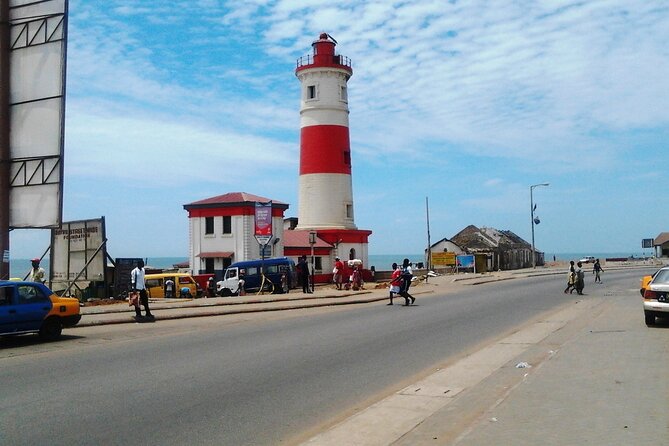
Jamestown is one of Accra’s oldest districts and is visited on foot. The walk includes James Fort and Ussher Fort, two colonial-era forts in old Accra.
The supplied details do not assign a fixed time to this stop, so the length may depend on traffic, access, and the rest of your day. That flexibility is useful, but it also means you should ask how much walking is planned before you set out.
Jamestown is important because it connects Accra’s modern streets with its colonial past. The forts are not just isolated buildings. They belong to an older port district shaped by trade, European power, and local communities.
This is likely to be one of the more physically demanding parts of the experience. You may walk in the sun and over uneven urban surfaces. If you have limited mobility or prefer less walking, discuss alternatives with the operator before the tour begins. Service animals are allowed, and most participants can take part, but the outdoor nature of the stop still matters.
The W.E.B. DuBois Center adds a Pan-African perspective
The W.E.B. DuBois Center is the home, library, and final resting place of William Edward Burghardt DuBois, the American-born campaigner for social justice. The site includes a museum with personal belongings and his library, as well as an open-air theatre used for lectures, seminars, workshops, and cultural events.
You are given about 45 minutes here. That is a reasonable amount of time to view the museum and understand why DuBois is remembered in Ghana.
This was a particularly meaningful stop for people interested in African and African American history. It adds an international dimension to the tour, showing how Ghana became connected to wider Pan-African ideas. It also breaks up the sequence of monuments and markets with a quieter, more reflective visit.
The center is one place where a guide’s preparation matters. Ask for context about DuBois’s connection to Ghana and his place in the country’s intellectual life. Some parts of the broader tour rely on staff at museums or on the guide’s own explanation, so direct questions are worthwhile.
Kwame Nkrumah Memorial Park honors independence leadership
The Kwame Nkrumah Memorial Park is dedicated to Ghana’s first Pan-African prime minister and president, Dr. Kwame Nkrumah, who lived from 1909 to 1972.
The visit lasts about 45 minutes. It pairs well with Independence Square because the earlier stop introduces the national symbols of independence, while this memorial focuses on one of the central political figures connected to that era.
I would use this stop to ask how Nkrumah’s leadership is remembered in Ghana today. The value is not only in taking a photograph at the memorial. It is in connecting the monument to the country’s political development and to the larger Pan-African ideas also represented at the DuBois Center.
As with the other outdoor locations, sun and heat can affect your comfort. The day has several stops, and the final beach visit may feel especially welcome after this stretch of city sightseeing.
Labadi Beach gives the day room to breathe
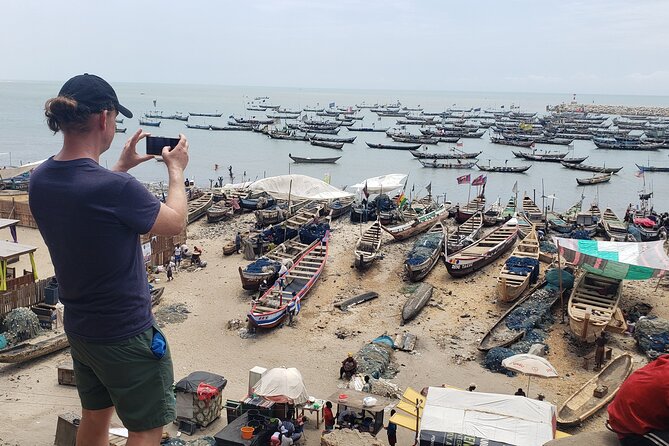
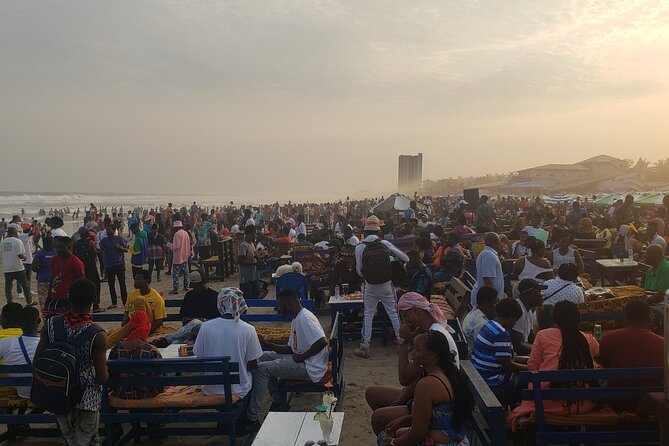
The tour ends at Labadi Beach, also known as La Pleasure Beach. It is described as the busiest beach on Ghana’s coast and one of Accra’s popular seaside places.
The planned beach stop lasts about an hour. You can sit, cool down, and buy local, continental, or international food and drinks. This is not simply a final photo stop. It gives the day a softer ending after museums, traffic, monuments, and market noise.
The beach is a good reason to avoid booking the tour too late in the day if you want time to relax there. The stated operating schedule runs Monday through Saturday from 9:30 a.m. to 11:30 p.m., but the tour itself is normally about three to six hours. Confirm the start time and expected finish so you are not rushing to another appointment.
If you want dinner by the coast, ask whether the beach portion can be timed around a meal. One full-day outing ended with dinner on the beach, which sounds like a sensible way to use the final stop.
Transportation is the key point to clarify
Pickup is offered, and the meeting point is Accra Mall at Plot C11, Tetteh Quarshie Interchange, Spintex Road. The activity ends back at the meeting point.
The important detail is that transportation between stops may not always be in one private tour vehicle. Because Accra traffic can be severe, the operator may use Uber, Yango, or local taxis, described as air-conditioned options. This approach can help the group move through congested streets, but it can also create waiting time.
One poor experience involved cancelled ride requests, a long wait at Independence Square, and uncertainty about vehicle arrangements. That is a serious concern if you are booking this tour specifically to avoid arranging local transportation yourself.
Before paying, ask three direct questions:
- Is a dedicated vehicle included for your group size?
- If taxis or ride services are used, who orders and pays for them?
- What happens if a driver cancels or traffic causes a major delay?
The private format is a strength, but transportation needs to be clear. For a group of four, a dedicated vehicle may feel more important than it does for a larger booking with a driver already arranged.
What $80 means in practical value
At $80 per person, this is not the cheapest way to see Accra. But the price includes a private experience, a local guide, admission tickets at the listed stops, market assistance, and the convenience of combining many parts of the city in one outing.
The value is strongest if you are visiting Accra for the first time, have limited time, and want someone else to connect the museums, memorials, market, historic district, and beach. You would spend time and money arranging those pieces separately, especially if you are unfamiliar with local transport.
The value is weaker if you prefer to explore slowly, already know Accra, or mainly want a private car and driver. In that case, the uncertainty around Uber, Yango, and local taxis may frustrate you.
The tour is often booked about 23 days ahead, so planning early is sensible. Free cancellation is available up to 24 hours before the start time. Changes or cancellations inside that window are not refundable.
Who should book this experience?
I would recommend it to first-time visitors, solo participants who want company and local help, couples, families, and small groups who want a broad introduction to Accra. The private setup makes it easier to ask questions and adjust the pace.
It suits people who like a full day with several different kinds of stops. Clinton has been praised for being engaging and attentive, while Alex and Kwame have been described as punctual, respectful, and helpful. Those personal qualities matter in a city tour, especially when the day includes bargaining, traffic, and schedule changes.
I would be more cautious if you dislike crowded markets, hot outdoor walks, or last-minute transport changes. Also be aware that not every site is guaranteed to operate on every day. Sunday closures already caused one outing to skip some planned locations.
Should you book the Accra Detailed City Tour?
Book it if you want a broad, guided introduction to Accra and you value local explanation more than a slow, carefully timed visit. The strongest parts are the range of sights, the private format, the chance to experience Makola Market, and the satisfying finish at Labadi Beach.
Before booking, get the transportation plan in writing. That single question may determine whether the $80 feels like good value. If a dedicated car is confirmed, this is a well-rounded way to get your bearings. If you will be arranging a string of ride-hailing trips yourself, consider how much independence and waiting you are willing to accept.
FAQ
How long does the Accra Detailed City Tour last?
The tour lasts approximately three to six hours. The exact length can vary with traffic, stop times, site opening hours, and transportation between locations.
Where does the tour start?
The meeting point is Accra Mall, Plot C11, Tetteh Quarshie Interchange, Spintex Road, Accra, Ghana.
Where does the tour end?
The activity ends back at the meeting point at Accra Mall.
Is pickup offered?
Yes, pickup is offered. The supplied information also lists Accra Mall as the meeting point, so confirm the exact pickup arrangement when booking.
Is this a private tour?
Yes. Only your own group participates in the private activity.
What transportation may be used between stops?
The operator may use Uber, Yango, or local taxi services to handle Accra traffic. These vehicles are described as air-conditioned, but you should confirm whether a dedicated vehicle will be provided for your booking.
Are admission tickets included?
Admission tickets are listed as included for the National Museum, Makola Market, Independence Square, the Centre for National Culture, the W.E.B. DuBois Center, Kwame Nkrumah Memorial Park, and Labadi Beach.
Can I cancel for a full refund?
Yes, if you cancel at least 24 hours before the experience begins. Cancellations or changes made less than 24 hours before the start time are not accepted for a refund.
Just added around Accra
- Experience Cape Coast Castle and Kakum National Park★ 4.5 · 3 reviews
- Experience Northern Ghana In 10-Days★ 5.0 · 3 reviews
- Discover Ghana – Wli Waterfalls, Mountain Afadjato, Monkey Sanctuary & Akosombo.★ 4.5 · 3 reviews
- Cultural Tour Of Ghana And South Africa 12 Days★ 5.0 · 3 reviews
- Accra: City Highlights Half-day Guided Tour with Transfers★ 4.1 · 3 reviews
- Accra: Half day private safari with pick up★ 3.5 · 3 reviews
- Full Day Accra Guided Tour★ 5.0 · 3 reviews
- Experience Aburi Botanical Gardens And Boti Water Falls In A Day.★ 5.0 · 3 reviews
City Tours, compared.




Escape Accra City to Aburi Gardens and Tetteh Quarshie Cocoa Farms
Read our review →
Browse the lists this tour appears in