
Reviewed · CITY TOURS
Half-Day City Tour of Accra
Accra makes Ghana’s story visible. This five-hour tour links Independence Square and the Kwame Nkrumah Memorial Park with Makola Market, James Town, and the Arts Center, giving you a useful first look at the capital’s politics, culture, commerce, and daily life. I like the broad mix, and I like that admission fees and bottled water are included.
The main drawback is the pace. Six stops in about five hours leave limited time at each place, especially if traffic slows the drive between them. At $100 per person, this is best value if you want a guided overview of Accra rather than a slow visit focused on one museum, market, or neighborhood.
In This Review
- Key points to know before booking
- Six stops that sketch out Accra
- Independence Square and the Black Star symbols
- Asomdwe Park and Ghana’s presidential memory
- Kwame Nkrumah Memorial Park and the independence story
- The Arts Center and Ghanaian crafts
- James Town Lighthouse and Accra’s coastal side
- Makola Market, where Accra gets practical
- What the guide adds to the day
- Is $100 a fair price for five hours?
- Timing, meeting point, and practical planning
- Who will enjoy this Accra tour?
- Should you book the Afro Nyanka Accra city tour?
- FAQ
- Where does the Accra city tour begin?
- Where does the tour end?
- How long does the tour last?
- What places are included?
- Is admission included?
- Is bottled water provided?
- How many people can join the tour?
Key points to know before booking
- Six very different Accra stops: The route moves from national monuments and presidential memorials to crafts, a lighthouse, and a major city market.
- A useful introduction to Ghanaian history: Independence Square and the Kwame Nkrumah Memorial Park give the tour a clear political and Pan-African focus.
- James Town adds a local neighborhood view: The lighthouse provides a change of scene from formal monuments and museums.
- Makola Market brings everyday Accra into the picture: You can see a wide range of goods, from car parts to land snails.
- Guides are a major part of the experience: Christ, Charles, and Noble have each been praised by name for being informative, friendly, and punctual.
- Simple logistics: The tour begins and ends at Accra Sports Stadium, includes all listed fees and taxes, and accepts mobile tickets.
Six stops that sketch out Accra

Accra is too large and layered to understand in one short outing. Still, this route makes a sensible first pass. You get national symbols, memorial sites, a cultural market, a historic coastal district, and the city’s central shopping streets.
The schedule assigns about one hour to Independence Square, one hour to the Center for National Culture, one hour to James Town Lighthouse, and one hour to Makola Market. Asomdwe Park and Kwame Nkrumah Memorial Park receive about 30 minutes each. That balance tells you what kind of tour this is: a broad survey, with enough time to look around but not enough for long, unhurried exploration.
I especially like the way the route shifts between official Ghana and lived Ghana. The monuments explain how the country remembers independence and leadership. The market and James Town show how Accra feels beyond its national symbols.
A few more Accra trips worth weighing up
- Half-Day Private History Tour in Nkyinkyim Museum
★ 5.0 · 9 reviews - Half-day Accra Guided Tour
★ 4.5 · 8 reviews - Half-Day Accra City Tour Experience
★ 5.0 · 7 reviews
Independence Square and the Black Star symbols
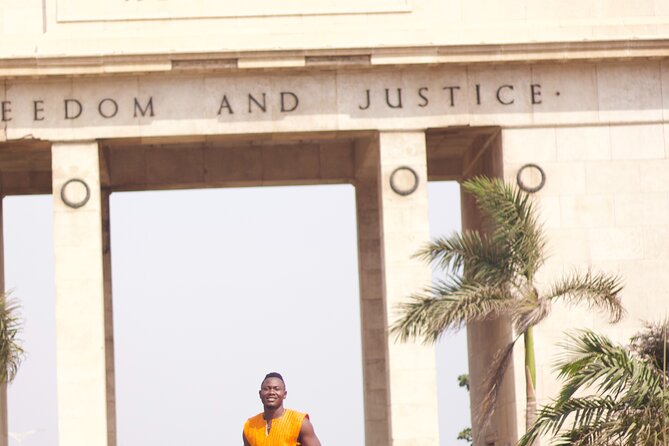
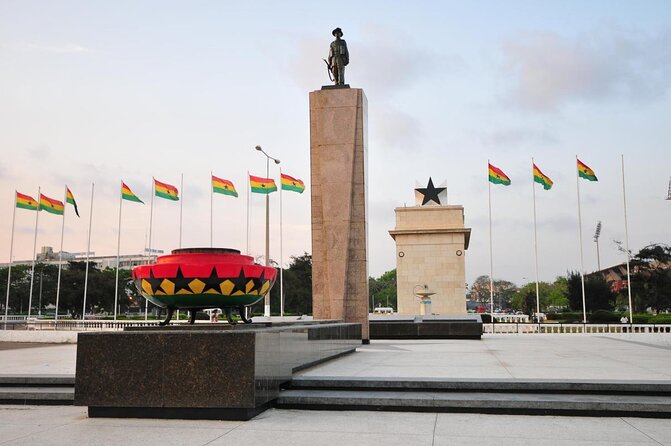
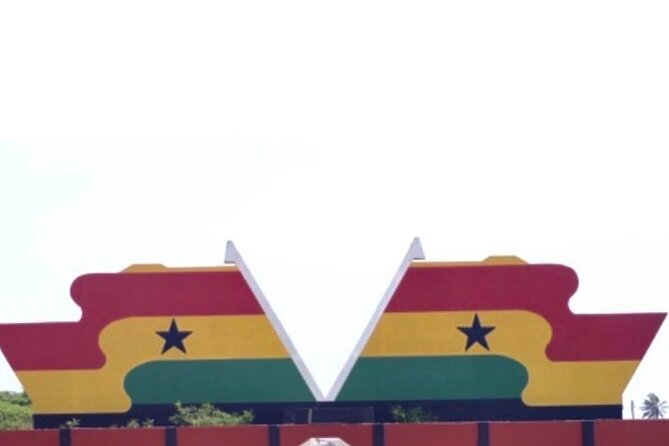
The first major stop is Independence Square, also known as Black Star Square. This broad ceremonial area contains the Independence Arch, Black Star Gate, and Liberation Day Monument.
Your accredited guide explains how these monuments relate to Ghana’s independence struggle. The setting is useful because it gives the country’s modern political story a physical place. You are not simply looking at an arch or gate. You are seeing a public space built around national identity, freedom, and remembrance.
Plan on about an hour here. That should give you time to hear the explanation, view the monuments, and take photographs. The square is also a good early stop because it establishes the historical theme that returns at Kwame Nkrumah Memorial Park.
The limitation is that a large ceremonial space can feel more formal than intimate. If you prefer small museums or hands-on exhibits, this stop may seem brief on detail. The guide’s explanation matters a great deal, so stay close and ask questions while the group is together.
Asomdwe Park and Ghana’s presidential memory
Asomdwe Park is a memorial park holding the mortal remains of former President J.E.A. Mills. The visit lasts about 30 minutes, making it a short but meaningful pause in the route.
This stop adds a more recent chapter to the tour. Independence Square looks at national liberation, while Asomdwe Park focuses on the memory of a Ghanaian president. Together, the two places show how Accra preserves different parts of its public past.
You should expect a quiet memorial setting rather than a large attraction packed with displays. The shorter visit is appropriate for the site, but it also means you will depend on your guide for context. If political history interests you, ask for clarification about Mills and the role of the park in Accra’s civic life.
The practical benefit is that the stop does not consume too much of your half-day. The tradeoff is simple: you will get an introduction, not an extended historical presentation.
Kwame Nkrumah Memorial Park and the independence story
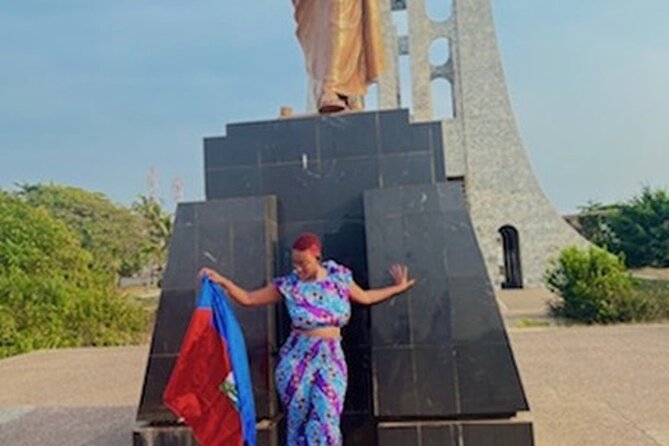
Kwame Nkrumah Memorial Park is one of the most important stops for understanding Ghana’s place in African history. The mausoleum is the final resting place of Ghana’s first president and an Africanist. A museum at the park contains artifacts connected with Ghana’s independence and the wider Sub-Saharan struggle for freedom.
I would give this stop your full attention. The park links one person, one country, and a larger movement across Africa. It also gives you a chance to connect what you saw at Independence Square with the political ideas behind Ghana’s independence.
The official timing is about 30 minutes, which is tight for a mausoleum, museum, and guided explanation. If your group moves quickly, you may need to focus on the main displays rather than read every item. Still, the stop can carry more meaning than its length suggests, especially when the guide adds context.
Christ has been praised for providing extra explanation during a museum visit, and guides such as Charles and Noble have also been singled out for making the tour informative and enjoyable. Guide quality is important here because artifacts make more sense when you understand their place in the independence movement and Pan-African thought.
More city tours in Accra:
- Accra Detailed City Tour
★ 4.5 · 118 reviews - Accra Guided City Tour Experience
★ 4.7 · 88 reviews - Accra Guided City Tour Experience
★ 5.0 · 76 reviews - Know Ghana in 4 hrs – Accra City Tour
★ 4.5 · 47 reviews
The Arts Center and Ghanaian crafts
The Center for National Culture, commonly known as the Arts Center, receives about an hour. This is the tour’s main stop for arts, crafts, and cultural shopping.
You can expect a different mood from the memorial sites. Instead of large national monuments, the focus turns to handmade goods and local creative work. The stop gives you room to browse and get a sense of Ghanaian craft traditions without giving up the rest of the city tour.
An hour is a useful amount of time, though your experience may depend on how much you want to shop. If you are curious about crafts, use the time to examine the work closely and ask your guide about what you are seeing. If shopping is not your priority, you may find the visit longer than the historical stops.
The Arts Center also brings up a practical point about guided shopping areas: you should decide in advance how much browsing you want to do. The tour includes admission fees and taxes, but it does not say that purchases are included. Treat anything you buy as a separate expense, and keep the market portion from taking all your attention if you want to stay with the group.
James Town Lighthouse and Accra’s coastal side

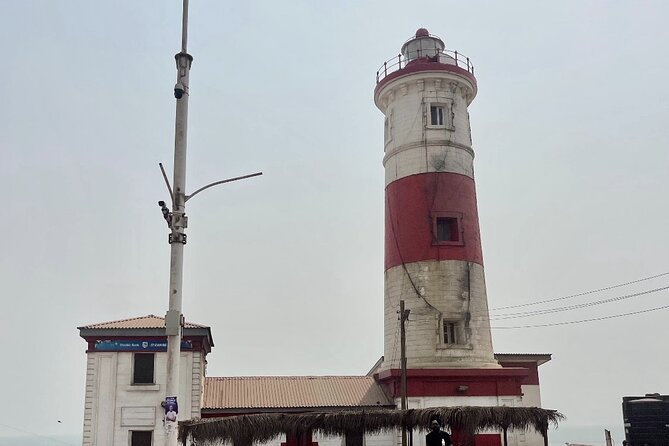
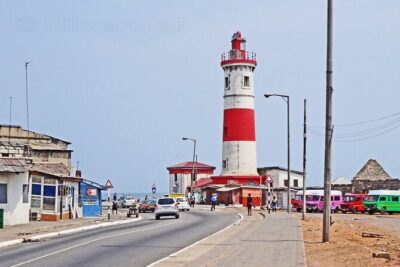
James Town Lighthouse provides the tour’s most distinctive change of setting. The structure consists of a stone tower with a lantern and gallery, attached to a keeper’s house. The visit is planned for about an hour.
The lighthouse helps you see Accra through its coastal and working-city identity rather than only through government monuments. Its architecture gives the guide a concrete way to explain the area, and the tower offers a memorable visual stop.
You should confirm with your guide what access is available during your visit. The information provided describes the lighthouse and its attached keeper’s house, but it does not promise that you can climb the tower or enter every part of the structure. That makes the guide’s on-site direction important.
An hour should allow time to see the building, hear its story, and take in James Town. The stop may feel less polished than the formal memorial sites, which is part of its value. You get a glimpse of an older part of Accra, but you should not expect a fully arranged museum experience.
Makola Market, where Accra gets practical

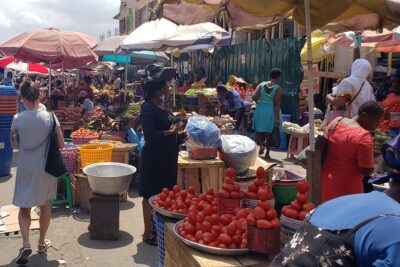
Makola Market is a major market and shopping district in central Accra. Its stalls and surrounding streets sell an unusually wide range of goods, from car parts to land snails.
This is where the tour moves closest to ordinary city life. The market is not included simply as a shopping break. It shows how much commerce can fit into one part of Accra and how varied the city’s trade can be.
You have about an hour here. That is enough to walk through a section of the market and take in the scene, but it is not enough to cover every street. Stay aware of the meeting time. Markets are easy places to lose track of time, especially when your attention keeps shifting from food and household goods to clothing, tools, and unexpected items.
I would treat Makola as an observation stop first and a shopping stop second. The description does not specify particular products, prices, or bargaining arrangements, so do not arrive with a fixed shopping promise. Instead, use the hour to watch the flow of business and ask your guide how the market fits into Accra’s economy.
What the guide adds to the day
The route covers places that can look disconnected if you visit them without context. A guide ties the pieces together, explaining the independence struggle at Black Star Square, Ghana’s first president at the memorial park, J.E.A. Mills at Asomdwe Park, and the cultural role of the Arts Center.
Christ has been praised for adding useful explanation during a museum visit. Charles has been described as a lovely guide who made a family outing both informative and fun. Noble and Charles were also praised for being on time during another Accra city tour.
Those names suggest a strong focus on guide service, but your assigned guide may be different. The company is Afro Nyanka Tours, and the published experience identifies the guide as accredited without promising a particular person. If you are especially interested in Pan-Africanism, Ghana’s independence, or the history behind the museum displays, tell your guide early in the tour.
Is $100 a fair price for five hours?
The cost is $100 per person for approximately five hours. That is not a bargain-priced walk, so the value depends on what you want from your time in Accra.
The price includes all fees and taxes, admission to the listed stops, bottled water, and a guide. You are paying for a tightly arranged introduction across six locations, not just for transport between landmarks. For a first day in Accra, that broad coverage can be useful.
The value is weaker if you already know the city or want to spend a full afternoon at one museum or market. The schedule gives you a taste of each place, but you will not have unlimited time to read every museum display, browse every craft stall, or explore all of James Town.
A group can contain up to 30 people. That maximum is not especially small, and it may affect how easily you hear the guide or move through busy areas. On the other hand, the group size is still capped, and the tour avoids leaving you to arrange separate admission at each stop.
Timing, meeting point, and practical planning
The tour begins and ends at Accra Sports Stadium, at 1272 Starlets 91 Road in Accra. Because the activity returns to the meeting point, you can plan around a known start and finish rather than arranging a separate drop-off.
The listed operating schedule provides three daily time blocks:
- 9:00 AM to 12:00 PM
- 12:30 PM to 3:30 PM
- 4:00 PM to 6:30 PM
There is a mismatch between those blocks and the stated five-hour duration. The tour description says approximately five hours, while the available operating windows are three hours or two and a half hours long. Confirm the exact departure and finish time when you book, especially if you have a flight, meal, or another activity afterward.
A mobile ticket is accepted, and booking confirmation is issued at the time of purchase. Public transportation is nearby, and service animals are allowed. Most people can participate, but the information does not provide detailed guidance about walking distances, tower access, surfaces, or vehicle arrangements.
The route includes markets and public sites, so listen carefully to your guide’s instructions about staying with the group. Bottled water is included, which is a small but useful touch during a five-hour city outing.
Who will enjoy this Accra tour?
I would recommend this experience if you are visiting Accra for the first time and want a guided introduction in one half-day. It suits you if you want history, monuments, crafts, shopping, and a coastal neighborhood in the same outing.
It is also a good fit if you prefer having an accredited guide explain the meaning behind places that might otherwise look like a collection of buildings and public spaces. The positive feedback about Christ, Charles, and Noble gives the guiding side of the experience particular weight.
You may want something else if you prefer a slow pace, independent wandering, or a specialist history tour. The six-stop plan is ambitious. You will see a lot, but you will also move on before every location has been fully explored.
The tour can work well for families and mixed-interest groups because the itinerary changes often. One person can focus on history, another on crafts, and another on markets. The maximum group size of 30 may feel less personal than a very small private tour, so keep that in mind when comparing prices.
Should you book the Afro Nyanka Accra city tour?
Book it if you want a well-filled introduction to Accra and value a guide who can connect national history with daily city life. The strongest parts are the range of stops, the included admissions, the museum context, and the chance to visit both major monuments and places such as Makola Market and James Town.
Think twice if you need a relaxed schedule or exact timing. The $100 price makes the tour worthwhile when you use it as a first orientation to the capital, but less attractive if you plan to return to each stop on your own.
Before paying, confirm the exact departure time, ask which guide is assigned, and decide how much shopping time you want at the Arts Center and Makola Market. With those points clear, this is a practical way to meet Accra in one concentrated morning or afternoon.
FAQ
Where does the Accra city tour begin?
It begins at Accra Sports Stadium, 1272 Starlets 91 Road, Accra, Ghana.
Where does the tour end?
The activity ends back at the meeting point at Accra Sports Stadium.
How long does the tour last?
The stated duration is approximately five hours.
What places are included?
The tour visits Independence Square, Asomdwe Park, Kwame Nkrumah Memorial Park, the Center for National Culture, James Town Lighthouse, and Makola Market.
Is admission included?
Yes. All listed admission fees, taxes, and fees are included in the price.
Is bottled water provided?
Yes. Bottled water is included.
How many people can join the tour?
The maximum group size is 30 people.
Just added around Accra
- Experience Cape Coast Castle and Kakum National Park★ 4.5 · 3 reviews
- Experience Northern Ghana In 10-Days★ 5.0 · 3 reviews
- Discover Ghana – Wli Waterfalls, Mountain Afadjato, Monkey Sanctuary & Akosombo.★ 4.5 · 3 reviews
- Cultural Tour Of Ghana And South Africa 12 Days★ 5.0 · 3 reviews
- Accra: City Highlights Half-day Guided Tour with Transfers★ 4.1 · 3 reviews
- Accra: Half day private safari with pick up★ 3.5 · 3 reviews
- Full Day Accra Guided Tour★ 5.0 · 3 reviews
- Experience Aburi Botanical Gardens And Boti Water Falls In A Day.★ 5.0 · 3 reviews
City Tours, compared.




Escape Accra City to Aburi Gardens and Tetteh Quarshie Cocoa Farms
Read our review →
Browse the lists this tour appears in